

New Fluorescent Nanosensor Enables Rapid, First-of-its-kind Detection of Key Gut Health Biomarker

Singapore, 2 June 2026 - Researchers from the National Institute of Education, Nanyang Technological University, Singapore (NIE NTU, Singapore) and Singapore-MIT Alliance for Research and Technology (SMART) - Massachusetts Institute of Technology’s (MIT) research enterprise in Singapore - in collaboration with clinicians from the National University Hospital (NUH) and Yong Loo Lin School of Medicine, National University of Singapore (NUS Medicine), have developed a novel fluorescent nanosensor capable of rapidly detecting indole-3-propionic acid (IPA), an emerging biomarker linked to gut health and disease.
IPA is a metabolite produced by gut bacteria during the breakdown of dietary tryptophan, an amino acid essential for protein synthesis. It plays an important role in regulating inflammation and oxidative stress, and has been associated with conditions such as inflammatory bowel disease (IBD), type 2 diabetes, and liver disease. However, current detection methods rely on traditional mass spectrometry-based analytical techniques, which are costly and time-consuming, making it impractical for routine screening or point-of-care use.

Schematic of the fluorescent nanosensor platform showing rapid detection of indole-3-propionic acid (IPA) and differentiation between healthy and diseased samples. (Photo: NIE/NTU)
First Real-Time Sensor for an Indole-based Metabolite Gut Biomarker
The newly developed platform, the first reported optical nanosensor specifically designed to detect IPA, addresses a long-standing gap in gut metabolite sensing. Using a fluorescence-based approach, the sensor produces a rapid optical readout within minutes, offering a significantly faster and more accessible alternative to conventional analytical techniques. It demonstrates high selectivity, distinguishing IPA from closely related metabolites commonly found in the gut, which enables accurate detection even in complex biological environments such as blood serum.
“This is the first time we are able to directly and rapidly measure IPA levels in biological samples using an optical nanosensor,” said Assistant Professor Mervin Ang, NIE, and co-first author, who was also Associate Scientific Director at SMART DiSTAP when the research was initiated. “This novel approach, which moves away from traditional mass spectrometry, can pave the way towards faster and more accessible ways of monitoring gut health in real-world settings.”
This latest breakthrough is described in the research team’s paper, Fluorescent Nanosensor for Indole-3-Propionic Acid Detection in Gut Health Monitoring, published in the journal Advanced Healthcare Materials. The new nanosensor builds on SMART’s Disruptive & Sustainable Technologies for Agricultural Precision (DiSTAP) interdisciplinary research group’s (IRG) research into nano and optical sensor technologies. Originally developed to monitor plant health - including plant growth signals and stress responses - the technology has now been adapted for human health applications by redesigning the nano- and optical-sensing platform to detect IPA.
“This work builds on technology at SMART DiSTAP on molecular recognition. We have used techniques like this to measure hormones and metabolites in living plants for agriculture, and have now applied it to the human gastrointestinal system. We were able to apply it to this long-standing challenge in gut health,” said Professor Michael Strano, SMART DiSTAP Lead Principal Investigator, Carbon P. Dubbs Professor of Chemical Engineering at MIT, and corresponding author. “By focusing our molecular recognition on this important gut health biomarker, we’ve demonstrated a powerful new tool that could one day enable proactive, personalised healthcare. The tool promises near-instant insights into gut wellness or the status of chronic diseases like IBD.”
A Dual-Mode Platform for Rapid Testing and Future Monitoring
A key innovation of the technology is its dual-mode sensing capability. The nanosensor operates in both:
a visible fluorescence mode, enabling rapid, low-cost, high-throughput screening of biological samples; and
a near-infrared mode, with wavelengths that can penetrate deeper into tissues. The near-infrared capability allows the technology to be adapted for in vivo applications and integration into wearable devices that could be used for home-based testing or continuous monitoring. This could, for example, help patients with chronic conditions like IBD detect flare-ups earlier and manage their health with greater autonomy.
This flexibility allows the platform to be utilised in various environments, from laboratory tests to hospital bedside use, and wearable devices for real-time health monitoring.
Validated in Patient Samples
To evaluate its clinical relevance, the research team partnered with NUH clinicians to test the nanosensor on 125 human plasma samples across multiple patient groups, including healthy individuals and those with gastrointestinal diseases.
The study revealed significant differences in IPA levels between healthy individuals and patients with inflammatory bowel diseases, including Crohn’s disease and ulcerative colitis. Patients with active gut inflammation showed lower IPA levels — consistent with established clinical findings.
“From a clinical perspective, having a rapid and minimally complex way to assess metabolite levels like IPA could be very valuable,” said Adjunct Associate Professor Jonathan Lee, Senior Consultant, Division of Gastroenterology and Hepatology, Department of Medicine, NUH and NUS Medicine, and co-first author. “It has the potential to complement existing diagnostic tools and provide additional insights into patients with inflammatory bowel diseases.”
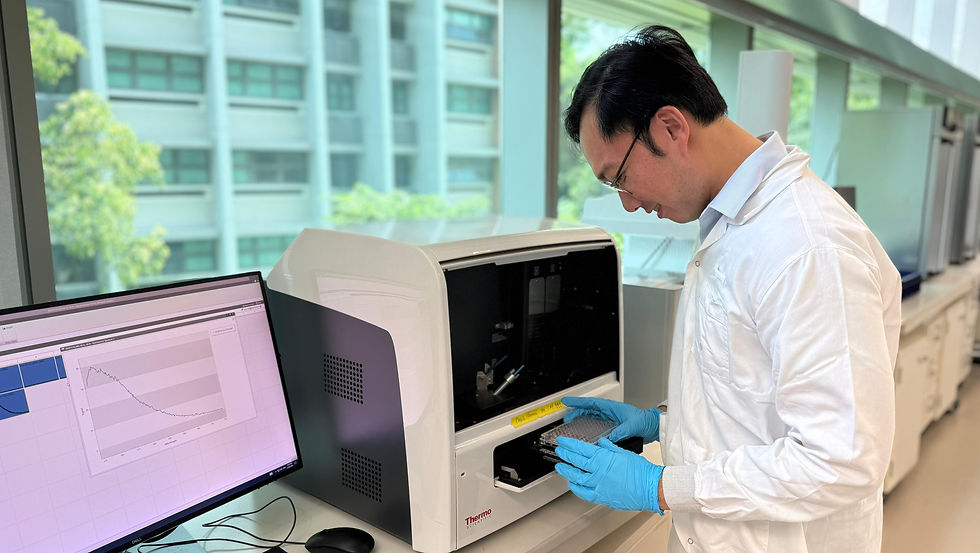
Assistant Professor Mervin Ang conducting sensor measurements using the fluorescence spectrometer. (Photo: NIE/NTU)
Faster, More Accessible Gut Health Testing
Beyond the laboratory, this research could pave the way for faster and more accessible gut health testing. Instead of relying on complex and time-intensive laboratory methods, the new nanosensor could enable rapid screening in clinics, or even portable or home-based testing, helping to detect gut diseases earlier and monitor treatment progress more easily.
Unlike conventional microbiome tests that focus on identifying which bacteria are present, this nanosensor measures what those microbes are actively producing, offering a more direct and functional snapshot of gut health. Directly measuring metabolite output, rather than bacterial composition alone, could provide more meaningful insights into overall health and support more personalised approaches to healthcare.
Beyond clinical diagnostics, the technology can be used to track the immediate efficacy of dietary interventions. Users can see rapidly if specific foods or probiotics are successfully fueling their gut bacteria to produce anti-inflammatory molecules like IPA. The sensor also demonstrated reliable performance in complex biological fluids such as serum and plasma, an important step toward real-world clinical deployment and further translational applications.
For pharmaceutical and therapeutic research, the nanosensor could be used to conduct rapid functional tests to determine the efficacy of new therapeutics or probiotics. By providing an instant readout of IPA levels, the platform could enable them to demonstrate in real-time that their therapeutics are biologically active and effective, significantly accelerating drug screening and dosage optimisation processes.
Towards Point-of-Care Diagnostics and Beyond
“The transition from laboratory discovery to a point-of-care clinical tool is already underway,” said Assistant Professor Ang. With further development, the platform has the potential to be translated into clinical applications, and in the long term, adapted into portable platforms for routine health monitoring.”
Looking ahead, the research team has been awarded an Innovation to Startup (I2Start) Innovation Grant to incubate a Singapore proto-startup to advance validation and development. The focus would be to translate the sensor into a point-of-care clinical diagnostic tool, and aim to expand the platform to detect multiple gut metabolites simultaneously and AI-driven signal deconvolution, enabling more accurate, comprehensive and personalised gut health monitoring. Future developments may also explore integration into wearable devices, microneedle systems, or microfluidic platforms for continuous, real-time sensing.
The research was supported by the Intra-CREATE Seed Collaboration Grant, and research conducted at SMART was supported by the National Research Foundation Singapore under its Campus for Research Excellence and Technological Enterprise (CREATE) programme.


Comments